
What is bounce rate?
Ash Williams · Aug 27, 2026I’ll get straight to the point: bounce rate is the percentage of visitors who view exactly one page and leave.
If 100 people visit your site and 50 of them never open a second page, your bounce rate is 50%. Whether that 50% is good or bad is the real question, and it depends entirely on what the page is for.
How bounce rate is calculated
The formula is:
Bounce rate = (single-page visitors ÷ all visitors) × 100
A bounce is about pages, not time. Only one page viewed is a bounce, no matter how long someone stayed.
Someone can sit on a blog post for eight minutes, get the answer, and close the tab. That is still a bounce. Someone can land on your homepage, then click to your pricing page ten seconds later, and that is not a bounce.
The time window matters
This is the part most articles skip, and it is why the same site can show different bounce rates in different tools.
We use a 24-hour session window. It is the same window we use to count unique visitors, so bounce rate lines up with the rest of your numbers instead of running on a separate clock. We do not use cookies to recognise people. Instead, each visitor gets an anonymous privacy-preserving signature that lasts a day and then resets, so everything one person does in that 24-hour window counts as a single visit. If someone reads a post at 9am, leaves, and comes back at 1pm to open a second page, both pageviews fall inside the same 24-hour window. Fathom sees one visitor who viewed two pages, so it is not a bounce.
We used to use a 30-minute window for bounce rate. Jack wrote that it always felt wrong, and he was right. That same visitor would have counted as a bounce back then: a second pageview only cancelled the bounce if it arrived within 30 minutes, so returning after lunch was too late.
With the 24-hour window, your bounce rate comes out lower, and it reflects real behaviour.
Bounce rate vs exit rate vs engagement rate
These get used as if they are the same number, but they are not.
Bounce rate is one-page visits. The visit started and ended on the same page.
Exit rate is the share of visits that ended on a given page, even if the person had already viewed three others. Your thank-you page should have high exit rate, as that is the point of the page.
Engagement rate is a Google Analytics 4 metric, and it measures something quite different. GA4 counts a visit as “engaged” if it lasts longer than 10 seconds, fires a key event, or has two or more pageviews. GA4 does still report bounce rate, but only as the flip side of that: 100% minus the engagement rate. So someone who reads a single article for four minutes counts as engaged in GA4, not a bounce, even though classic bounce rate would count it as a bounce because they only saw one page. The two numbers measure different things, so you cannot compare them.
We still report classic bounce on purpose, because people ask for it. We also measure time on site from departure pings, even on single-page visits, so a bounce still records how long someone stayed instead of showing zero time spent on a page.
What is a good bounce rate?
There is no one “good” bounce rate. You’re probably thinking, “Well, surely a lower bounce rate is better?” And yeah, typically that’s what you’d hope for. But the more useful question is: what is this page for?
Some pages only have one job, like a help article, pricing page, contact page, or order confirmation. A person finds the answer they’re looking for and leaves the page, so a bounce rate of 70% or even 80% can be perfectly fine.
But for a homepage, category page, product listing, or multi-step signup, you’d usually expect a second click. A high bounce rate on those pages is worth a closer look, as it can suggest that something about the promise, the speed, or the next step isn’t quite working.
Browse-heavy sites like ecommerce tend to run lower, because the whole point is to look at more than one thing. Content sites tend to run higher, because often a single article does the job. That is also why I won’t give you a fake industry benchmark table: those numbers mix tools, years, and page types until the average means nothing.
A better check:
- Compare the page to itself last month.
- Split it by source. Someone who finds a blog post through a search engine is likely to bounce more than someone who searches for your brand and lands on your homepage. That’s a difference in intent, not necessarily a sign that the page is broken.
- Split by device if one is wildly different. That is often speed or a layout that does not work on a phone.
- Ignore a 0% or 100% bounce rate on ten visits, as there isn’t enough data there to tell you anything meaningful.
If the whole site is under 20% and you are not a web app, check the tracking. Duplicate scripts and pageview requests that fire on load can make bounce look impossibly low.
We’re not trying to get your bounce rate down to 0%. Accidental landings, closed tabs, and one-page jobs will always exist.
Why a high bounce rate is not always bad
If someone lands on a page, gets the answer they came for and leaves, that is not necessarily a bad thing. Sometimes the page has simply done its job. Adding related posts just to try and lower the bounce rate can end up pushing people to click on things they were never interested in.
The cases I actually worry about:
- The title or ad promised something the page does not have.
- The page is slow or broken on mobile.
- A popup covers the page before they can read it.
- A campaign is sending the wrong audience to the wrong URL.
Those are worth fixing. Someone reading your answer and leaving happy is not.
How to see bounce rate in Fathom Analytics
On the dashboard, bounce rate is one of the metrics in the totals box at the top. Click it to show or hide it on the chart.
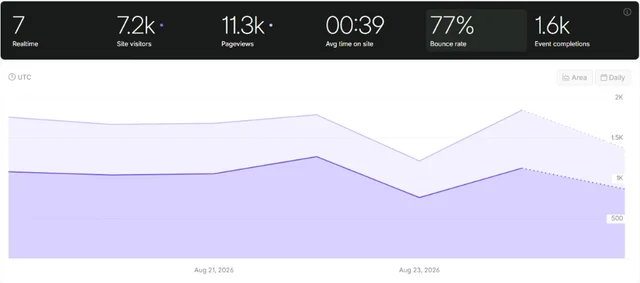
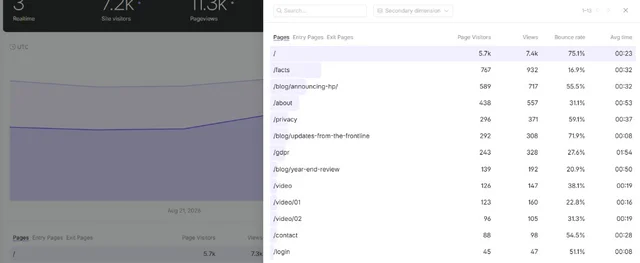
Open the details view on Pages, Referrers, or any other box and you get bounce rate per row. You can sort by it. Filter to a specific page, a source, or a UTM and the whole dashboard, including bounce rate, recalculates for that same group of visitors. That is the useful version of the metric: not a site-wide number, but “what happened to people who landed on this URL from this campaign.”
Start measuring bounce rate on your site
If you want to measure bounce rate on your own site, start a free trial of Fathom Analytics.
It takes a couple of minutes to add the script, and you will see bounce rate on the dashboard as soon as people start landing.
You can click around the live demo first if you just want to see the metric in place.

BIO
Ash Williams, Head of Growth
