Share a dashboard
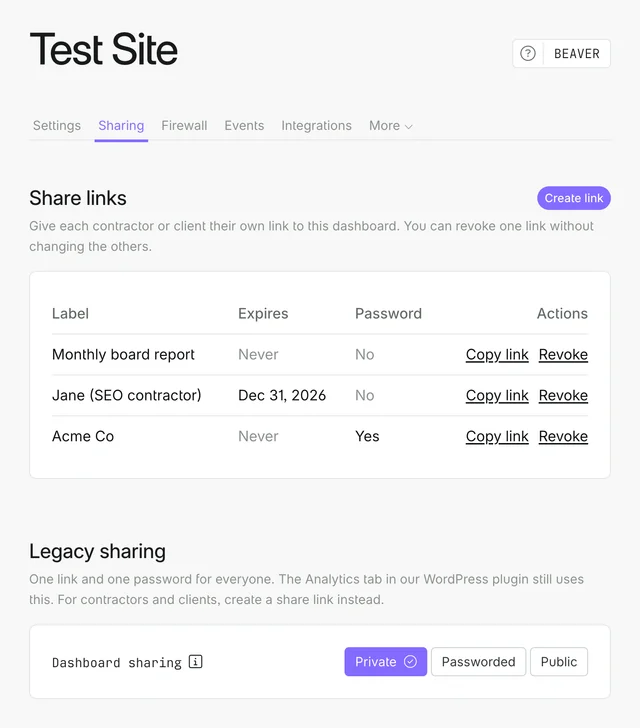
By default, you (the account holder) are the only person who can view your Fathom dashboard. To share it, go to Settings, click on your site name, and open the Sharing tab.
There are two ways to share a dashboard:
- Share links: a separate link for each person, with an optional password and expiry date. You can revoke one link without changing the others. Use these for clients, contractors and colleagues.
- Legacy sharing: one share URL and one password for everyone. Our WordPress plugin uses this.
Note: we are in the process of adding fully functional user accounts as a feature in Fathom. We’ll be letting customers know once this is available.
Create a share link
- Go to
Settings, click on your site name, and open theSharingtab. - Click
Create link. - Type a
Label, such as the person’s name or company. Only you see the label, so you know who has each link. - If you want the link to stop working on a set date, choose a date in
Expires on (optional). The link stops working at the end of that day, in your site’s timezone. - If you want a password, type one in
Password (optional)(at least 8 characters), or clickGenerateto create a strong one. - Click
Create linkat the bottom of the window. - Copy the link (and the password, if you set one) and send them to the person.
You can only copy the password before you close this window. We only keep a hashed version of it, so we can’t show it to you again. To change a password, revoke the link and create a new one.
Each site can have up to 100 share links.
What people see with a share link
Anyone with the link sees your dashboard as a viewer. They can change the date range, apply filters and download the dashboard, but they can’t change any settings or see your other sites.
If the link has a password, they need to type it before they see the dashboard. Share links work even when legacy sharing is set to Private.
If a link has expired or you’ve revoked it, the person sees a page that says the link doesn’t exist, has expired, or was revoked.
Revoke a share link
- Go to the
Sharingtab for your site. - Find the link in the list and click
Revoke. - Click
Revoke linkto confirm.
Anyone using that link loses access straight away. If they have the dashboard open, it stops loading data. Your other share links keep working.
Expired links stay in the list, marked Expired, until you revoke them. If you transfer a site to another Fathom account, we revoke all of its share links.
Legacy sharing
Legacy sharing gives your site one share URL and, if you want, one password that everyone uses. You’ll find it under Legacy sharing on the Sharing tab. Set Dashboard sharing to one of these:
- Private: the default setting (i.e. what your dashboard is set to unless you specifically change this setting.) Meaning only you, the account owner with Fathom, can view this dashboard (and anyone you’ve given a share link).
- Passworded: anyone who has your share URL and the password you set can view this dashboard. Viewers who use that password cannot change any settings, add events, or do anything in your Fathom account. It’s a view-only function. You can change this password at any time, but everyone who uses it loses access until you send them the new one. To cut off one person, use share links instead.
- Public: your dashboard is public on the internet to anyone who has the share URL. This is useful if you want public stats (like our demo).
You can change your share settings at any time to make your dashboard as private or as public as you’d like.
Exporting data from a shared dashboard
Anyone who opens your dashboard with a share link or a passworded share URL can export the data they see.
When viewing a shared dashboard, you’ll see a download icon button in the top-right corner of the dashboard (next to the filters button). Clicking this and choosing Download Dashboard will download a ZIP file containing CSV files of the dashboard data, including any filters or date ranges you’ve applied.
This is useful when you need to give clients, team members, or stakeholders the ability to download their own reports without needing access to your Fathom account.
For more details on what’s included in the export and how it works, see our exporting data documentation.
Note: Data export isn't available on a public share URL (without a password), as we want to ensure data can only be downloaded by people you've chosen.
Show or hide the sharing banner
The sharing banner is off by default, so it won’t appear on your shared dashboards unless you turn it on.
If you’d like, you can show a small Fathom banner at the bottom of your shared dashboards. Anyone viewing the dashboard can start a free trial through your referral link, so you earn 25% lifetime commission on every paying customer, and they get $10 off their first invoice.
To change it, go to Settings, Partners, open the Sharing tab and find the Shared dashboard banner section.
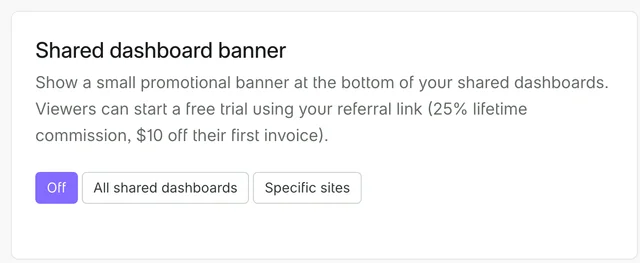
Then pick one of these:
- Off: the banner doesn’t appear on any of your shared dashboards.
- All shared dashboards: the banner appears on every dashboard you share.
- Specific sites: the banner only appears on the shared dashboards you choose.
These options appear once at least one of your sites uses legacy sharing. The banner is never shown on share links, to viewers who are logged in to Fathom, or when a dashboard is opened with a ?password= URL (like the one below, or our WordPress plugin).
Share a passworded dashboard without asking visitors for a password
A share link without a password does this for you, and you can revoke it at any time. The steps below are for legacy sharing.
By default, passworded dashboards require a password each time someone wants to view them. The password can’t be saved because this isn’t a “true” user account; it’s a shared password to view a dashboard.
If you want to share a passworded dashboard but not require people to enter that shared password each time, you can by adjusting the share URL:
- Make sure
Dashboard sharingis set toPasswordedunderLegacy sharingon your site’sSharingtab. - Copy your Share password, for example,
badpassword, and paste it into a SHA256 encryption tool like md5decrypt.net (paste your password and clickEncrypt). - Copy the SHA256 hash, for example, if your password was
badpasswordthe hash code would be3693d93220b28a03d3c70bdc1cab2b890c65a2e6baff3d4a2a651b713c161c5c. - Copy the Share URL; it’ll be something like:
https://app.usefathom.com/share/random/your-site-name, whererandomis your Site ID, andyour-site-nameis the name of your site. - On the end of your Share URL, add
?password=3693d93220b28a03d3c70bdc1cab2b890c65a2e6baff3d4a2a651b713c161c5cwhere that string is your hash code.
So the URL you would share (which now doesn’t require a password for a Passworded dashboard) is:
https://app.usefathom.com/share/random/your-site-name?password=3693d93220b28a03d3c70bdc1cab2b890c65a2e6baff3d4a2a651b713c161c5cBut you would change random and your-site-name to the correct values, and you’d change the string after ?password= to the correct SHA256 hash.
Note: This only works because shared passwords are stored as plain text (obviously, this is not how our username/passwords work, as that'd be super un-secure).